Screen time · Parenting
A screen-time plan for families that counts the right thing
Stop counting hours and start counting what your child makes. A one-week tally, the Screen Quadrant, and the MAKER test add up to a family plan that works.
 Dr. Philip Hickman · 6 min read
Picture two eleven-year-olds who each spent three hours on a screen last Saturday. One watched video after video, autoplay on, alone in his room. The other built a working machine in a block game, then showed it to her dad and answered his questions about how it worked. Same number on the screen-time report. Completely different afternoons.
That’s why I stopped asking families how many hours. The clock measures dose. It can’t tell you what your child was doing or who was there, and those two things matter more.
Two questions, four corners
Every screen session can be sorted with two questions.
- Is my child consuming or creating? Does anything exist afterward that didn’t exist before?
- Is my child alone or with someone? Not in the room: on the screen. Is someone watching with her, playing with her, building with her, or on the other end of the call?
Draw those as two crossing lines and you get four corners. In Screen Time Is Good I call this picture the Screen Quadrant.
- The feed (alone, consuming): autoplay video, algorithmic social media, solo scrolling. An algorithm chooses what happens next, nobody is there, and nothing exists afterward. Nearly every harm with strong evidence behind it lives in this corner.
- Co-viewing (together, consuming): a family film, a video call with a grandparent. A person chooses, someone is beside the child, and what’s left is a shared memory or a conversation.
- The studio (alone, creating): building in a game, coding, editing a film. The child chooses, and what’s left is something she made.
- The team (together, creating): a robotics team, cousins building on a shared server, a child showing her film to her grandmother. What’s left is something made and a relationship. It’s the best thing a screen does.
Notice that “YouTube,” “Minecraft,” and “educational app” aren’t categories. Each one can land in any corner depending on how it’s used. The parent’s job, stated as plainly as I can, is to move your child up and to the right: from consuming toward creating, from alone toward together.
I counted the wrong thing too
When I was a superintendent, I put a device in the hands of every student in the district and reported the project by the number of devices. A year later I sorted the usage report by application. At the top were a drill program and a video site. Far below was the one tool where a child could build anything. We had bought the right side of the quadrant and delivered the left. The count was never the point.
Week one: dots, not minutes
Before you change a single rule, find out where your child’s screen time actually goes.
Draw the quadrant on a sheet of paper, label the corners, and tape it to the refrigerator. For seven days, every time your child finishes a stretch on a screen, put one dot in the corner where it happened. One dot per session, placed honestly. Don’t count minutes.
On day seven, look. Most families find a cluster in the feed and a few lonely dots on the right. Don’t panic, and don’t confiscate anything. Pick one activity from the lower-left and ask what it would take to move it one box: a person in the room, or a thing to make.
The number to watch: the creation ratio
A plan needs a number or it drifts. Mine isn’t hours. It’s the creation ratio: making sessions divided by all sessions in a week.
There’s no research-based target, and I won’t invent one. As a household rule of thumb, I suggest making in at least a third of sessions for children six and up, with the feed column trending toward empty for everyone under fourteen. For a five-year-old, the ratio matters less than the company. The question at that age is whether an adult was in the session, and the answer should always be yes.
The MAKER test for any app
When your child asks for a new app, game, or device, run five questions and count the yeses.
- M: Makes something new. Does the child leave with something she made, not just a score or a streak?
- A: Adapts to the child. Does it respond to her, getting harder as she improves, instead of making her adapt to it?
- K: Keeps them thinking. Does it make her decide, debug, and revise, or does it think for her?
- E: Ends with something to show. Is there a finish line?
- R: Reaches others. Does it connect her to someone, share what she made, or get built with a peer or parent?
Five yes is a tool. Five no is a pacifier. Most things land in between, and the score tells you more than the label on the box.
Fit the plan to each child
One rule for every child in the house is guaranteed to be too loose for one and too tight for another. The American Academy of Pediatrics guidance from 2016 works by age instead: avoid screen media other than video-chatting before 18 months; high-quality programming watched with a parent from 18 to 24 months; about an hour a day of high-quality, co-viewed programming from two to five; and from six on, consistent limits set by a family media plan rather than one hour count for everyone.
The ladder I use runs in the same direction: watch together, then watch and make together, then play and make together, then make alone and show together, then make alone for an audience. Notice that no rung says alone, consuming, chosen by a machine. The feed isn’t a stage children grow into.
The harms I don’t negotiate
None of this means screens are harmless. Sleep is the harm underneath the others, and a tired child can look a lot like a child with an attention problem. My non-negotiables:
- Devices sleep in the kitchen, mine included, starting about an hour before the youngest child’s bedtime.
- Autoplay goes off, or the program goes.
- No algorithmic feed before mid-adolescence.
- No AI companion marketed as a friend.
- No screens at the dinner table, starting with mine.
A one-page plan
Make one column per child and one for the parents. Then fill in these rows together at the kitchen table, starting with the youngest:
- Watch: what, when, and with whom
- Play: with whom, and which days
- Make together: one shared project a week
- Make alone: where (a table in a shared room, not a bedroom) and until what time
- Hold back: what’s off the table at this age
- Devices sleep: where, and starting when
- Weekly question: “Show me what you made.”
- Next rung: what changes at the next birthday
The parent column isn’t a joke. A plan the parents are exempt from is just a rule, and kids can tell the difference.
What to do this week
- Tape a blank quadrant to the refrigerator and start the dots tonight.
- At dinner, with devices in a drawer, ask each child: “What do you want to make this month?” Write the answers down exactly as they come.
- Choose one charging spot and move every device there an hour before the youngest child’s bedtime.
- Run the MAKER test out loud on the app your child uses most.
- Next Sunday, figure out the creation ratio together and ask: “Which corner would you like to grow?”
To place your own family’s week in the four corners, try the free Screen Quadrant tool.
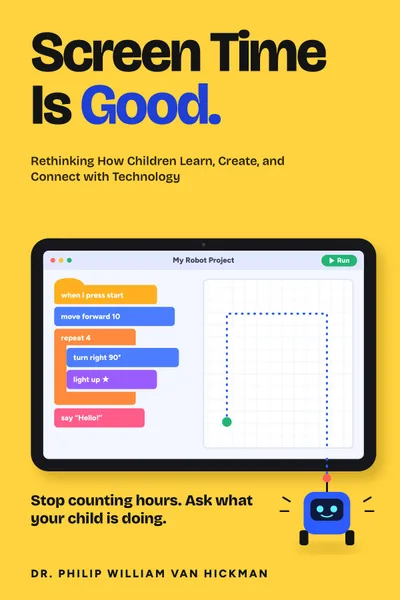 From the bookScreen Time Is GoodRethinking How Children Learn, Create, and Connect with Technology