Parenting · Confidence
Changing the voice in your child's head with the Hallway Check
Kids turn 'you are' into 'I am.' Four questions, short coaching cues, and repair scripts help parents shape the inner voice a child carries for years.
 Dr. Philip Hickman · 6 min read
Picture a twelve-year-old who opens her school email and sees four words from her teacher: “Please see me tomorrow.” By dinner she has decided she’s failing, that the teacher doesn’t like her, and that she should probably fake a stomachache. Tomorrow, it turns out, the teacher wants to ask if she’d like to join the math team. She lost a whole evening to a story she wrote herself.
Every child has an inner voice that forecasts what’s coming. Some of it is useful. Some of it is old: words a child heard once, or a hundred times, that now play on their own under pressure. In Whispering Shadows I call those old messages whispering shadows. The goal isn’t to silence them. It’s to give your child a pause between hearing the voice and obeying it.
Kids turn “you are” into “I am”
Children don’t just hear what we say about what they did. They hear what we say about who they are, and they’re far more likely to keep the second one. “You’re so lazy” becomes “I’m lazy.” “You always ruin everything” becomes the voice in a sixteen-year-old’s head when a group project goes sideways.
That’s the hard news. The good news is that the process runs in both directions. The words and habits you give a child now can become the voice they carry.
The Hallway Check
This is the tool I want every child to have. It’s named for the walk down a school hallway to the office, when your mind writes the ending before you’ve heard the middle. It’s four questions for any threshold moment: the “see me” note, the unanswered text, the tryout list, the door you’re about to walk through.
- What am I expecting? Name the forecast. Saying it out loud creates a little space between you and the prediction.
- What do I actually know? Facts only. What could a camera have recorded?
- What else could this be? Come up with at least two other explanations. One should be neutral or positive.
- What is one useful next step? One action within your control that would help no matter which explanation is true.
Here’s how it sounds for the twelve-year-old.
- Expecting: “I’m in trouble.”
- Know: “She asked to see me. That’s all. My last quiz was fine.”
- Else: “She might want to talk about a project. It might be good news. It might be nothing.”
- Next step: “Reply ‘Sure, what time?’ and go to bed.”
The Hallway Check doesn’t switch off feelings. She might still be nervous. But she’ll walk in with her hands open instead of clenched.
How to teach it, word for word
Teach it on a calm day, not in the middle of a spiral. Try something like this:
“You know how your brain sometimes decides how something’s going to go before it happens? Everybody’s does. I want to show you four questions that help. Let’s try them on something small.”
Then practice on low-stakes moments: a friend who hasn’t texted back, a substitute teacher tomorrow. When a real moment comes, you only need to start it: “Okay. What are you expecting?” Let your child do the rest.
A few things that help:
- Don’t argue with the forecast. “You’re overreacting” rarely works, because to the child it doesn’t feel like overreacting. It feels like self-defense.
- Ask “What else could it be?” more than once. Kids get faster at adding a second possibility the more they practice.
- Keep the next step small. One step, not ten.
Give your child a coaching cue
The best self-talk doesn’t sound like a cheerleader or a critic. It sounds like a good coach: short, specific, and focused on what you can do next. Sport psychologists have studied this for years. A 2011 review of self-talk research led by Antonis Hatzigeorgiadis found a moderate, positive effect on performance, with bigger benefits for tasks that need precision and for athletes who had practiced their cues.
Help your child write one cue for a moment that tends to go badly.
- Write down what they usually say to themselves, word for word. (“I’m going to fail. Everyone else is finishing.”)
- Write one short cue instead, five words or fewer, about something they control. (“Read the whole question.” “Skip it, come back.” “Underline what it’s asking.”)
- Practice it out loud three times this week when the stakes are low: in the car, before an easy quiz.
A cue they’ve never practiced won’t show up under pressure. A cue they’ve said twenty times usually will.
Check the words you’re handing them
The psychologist June Tangney’s research separates guilt (“I did a bad thing”) from shame (“I am bad”). Guilt tends to move people toward repair. Shame tends to make them hide. Discipline isn’t the problem. What gets disciplined is.
Keep the limit. Change the target. A few rewrites:
- “You’re so careless.” becomes “Three answers were right, and you skipped the units on the others. Let’s check those.”
- “You never listen.” becomes “I asked twice for the shoes off the stairs. They’re still there. Please move them now.”
- “Why can’t you be more like your brother?” becomes “That rule is the same for everyone in this house.”
- “You’re hopeless in the mornings.” becomes “We were late twice this week. What would help tomorrow?”
Watch comparisons and sarcasm too. Younger kids often hear sarcasm literally, or they hear the contempt without catching the joke. And when things are tense, say the relationship out loud: “I’m upset about this, and I love you. Both are true.”
When you get it wrong, repair
You will say the wrong thing. Every parent does. What matters most is what you do next. A repair has three parts: take back the label, keep the consequence, and apologize.
“Earlier I said you were [the label]. That wasn’t true, and it wasn’t fair. You made a choice I’m not okay with, and we still need to deal with that. But you are not [the label]. I was tired and angry. I’m sorry.”
Kids who hear repairs learn that mistakes, including grown-ups’ mistakes, can be fixed. Over time you may hear the change in their own words: less “I’m bad,” more “I messed up.”
When to bring in help
A harsh inner voice is common, and these tools are for everyday use. They aren’t treatment. If your child’s self-talk stays harsh for weeks, seems to spread into more of life, or comes with changes in sleep, eating, friendships, or school, talk with the school counselor or school psychologist and your pediatrician. A licensed mental health professional can help sort out what’s going on.
If your child ever talks about wanting to die or hurting themselves, don’t wait. Call their doctor, and in the United States call or text 988 to reach the 988 Suicide and Crisis Lifeline. If there’s immediate danger, call 911.
What to do this week
- Write down three things you often say when you’re frustrated, word for word. Mark each one: behavior or identity?
- Rewrite one and practice the new version.
- Teach your child the four Hallway Check questions on a calm day, using something small.
- Help your child write one coaching cue, five words or fewer, and practice it three times.
- If you’ve said an old version recently, use the repair script tonight.
The free Hallway Check tool puts the four questions in your pocket, for you or your child, in the moment you need them. It’s for reflection, not a clinical measure.
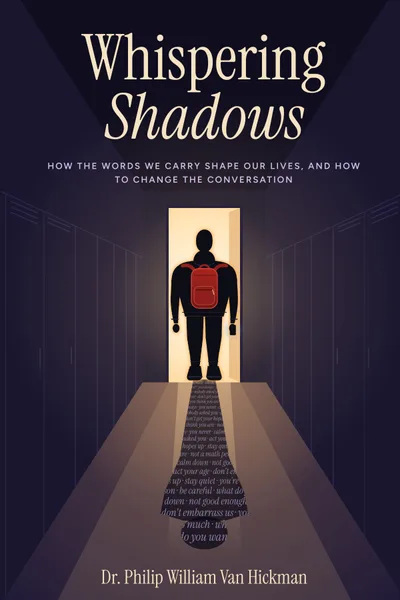 From the bookWhispering ShadowsHow the Words We Carry Shape Our Lives, and How to Change the Conversation