Teaching · AI and kids
A teacher's first week with AILE centers: a day-by-day plan
Co-Pilot, Chauffeur, Carpool, Caboose. A day-by-day first week with the High Impact Centers, with or without a dashboard, and every call stays yours.
 Dr. Philip Hickman · 5 min read
Picture your room at 9:45 on a Tuesday, running at four speeds at once. Three students at your table, working on the one idea that hasn’t landed. A cluster at laptops, each on a different version of the same practice. A group on the rug arguing over a shared problem. Two students by the window, proving what they know in their own way. That’s what the High Impact Centers look like when they work. The first week is about getting there without losing your footing, or your say over who goes where.
Four vehicles, one dispatcher
In The Intelligent Classroom, the AILE Framework keeps the four centers from my original ITI model and adds an intelligence layer. The names were never decoration. Each one tells you who holds the wheel, and each lines up with a phase of I Do, We Do, They Do (Ya’ll Do), and You Do.
- Co-Pilot is the teacher’s center, the I Do of the room. You pilot, and three to six students ride in the right seat. This is the most intensive, most human instruction you’ll give all day.
- Chauffeur is the We Do. Your design drives while eight to fourteen students ride adaptive paths toward a destination you set, often with an AI tutor.
- Carpool is They Do and Ya’ll Do. Peers share the ride in small groups with roles, while you navigate from a distance.
- Caboose is the You Do. The student rides at the back and watches her own train. This is where she proves mastery.
What AI adds is a dispatcher. A dashboard can recommend who starts where and flag who’s ready to move. But one rule runs the whole model: AI generates recommendations; teachers make decisions. Every move between centers is your call.
You don’t need a dashboard to start. The plan below runs on whatever evidence you have: last week’s exit tickets, a tool your district already allows, or your own notes.
Two rules for the week
Write these at the top of your plan before anything else.
- Every placement gets a reason you could say out loud to the student’s family.
- Every student changes vehicles at least once before Friday.
The second rule matters more than it looks. Intervention is a temporary support state, not an identity. No center should become a ceiling.
Sunday night: fill the planner (15 minutes)
Make a simple grid with one row per center and two columns: who starts here Monday and why, and what moves them out and by when.
- Co-Pilot: three to six students. Name the specific sub-skill and the evidence, never just “struggling.” Exit: two consecutive successes on that sub-skill in a new context. Target day: Wednesday.
- Chauffeur: students who have the concept and need practice with feedback. Mark who needs the acceleration path. Exit: a mastery flag or your own check. A student who stalls three times goes back to Co-Pilot the same day.
- Carpool: groups of three or four. Write the role each student holds and one reason for the mix. Exit: a private check for each member, never the group product. Target day: Thursday.
- Caboose: students with individual evidence of readiness. Note the mastery format each one chose.
Monday: launch the vehicles
Spend the first ten minutes teaching the names and what each one asks of students. The names do a lot of the teaching: “At Chauffeur, the plan drives. At Caboose, you’re watching your own learning.”
Run one short rotation and stay at Co-Pilot. Resist the urge to circulate everywhere. If a center wobbles, note what went wrong and fix the structure tomorrow instead of abandoning it today.
Tuesday: check your Chauffeur
Look hard at the tool or task your Chauffeur students use. The design principle that separates a tutor from a dependency machine is simple: every scaffold should have an exit ramp. Ask whether its default is a question or an answer.
If you use an AI tutor, read a few tutor logs for students’ explanations, not just their scores. And teach the skill most students have never been taught. In a 2025 RAND survey, more than 80 percent of students said their teachers hadn’t explicitly taught them how to use AI for schoolwork. Chauffeur is the natural place to teach when to accept a suggestion and how to question an explanation.
Wednesday: the Co-Pilot exit check
This is the decision most often skipped. Students sometimes stay in intervention long after the original need is resolved, simply because nobody looked. Check each Co-Pilot student against the exit you wrote on Sunday.
When a recommendation and your knowledge of a child disagree, you decide, and you write down why. Picture a dashboard saying a student is ready to leave your table because her accuracy is above the threshold, while you’ve watched her get moved too soon before. Keep her one more day, let her lead the explanation for a classmate, and annotate the override: “Accuracy is there; independence isn’t yet.” A note like that is the most valuable data point the system will get all week.
Thursday: Carpool, one student at a time
Group work at its worst produces collaborative theater: activity that looks like learning from across the room. Make individual accountability part of the structure.
- Give each student a private reflection question: “What did you contribute today that your group wouldn’t have had without you? What do you still not fully understand?”
- Run a short individual concept check before anyone rotates.
- Hold the line: a student’s ticket to Caboose is individual evidence, never the group’s grade.
If a tool tracks contribution, expect it to misread the quiet student who listens for a long time and then says the thing the group follows. You know that student. Dismiss the flag and write down why.
Friday: Caboose, and ten minutes for you
Caboose carries the biggest risk of shortcuts dressed up as learning. Hold three lines. AI may prompt, question, and respond to student work, but it may not generate it. Version history, oral explanations, and reflections are your authenticity signals, and you read them. And AI doesn’t confirm mastery. It surfaces evidence so you can.
Offer more than one route to the same standard: an oral defense, a product for a real problem, a short video reflection, a curated portfolio. More routes don’t lower the bar.
Then take ten minutes and answer three questions in writing.
- Who never moved this week? Who moved twice?
- Which recommendation did I override, and was I right?
- What will I change in Monday’s grid?
That note is next week’s first data point.
A word on equity
If the richest experiences reach one group while everyone else gets a worksheet on a laptop, the centers have reproduced sorting instead of reducing it. Device access, language access, and accommodations are design requirements, not extras. If you teach students with IEPs or 504 plans, invite the specialist who serves them into your planning for week two.
What to do this week
- Write the two rules at the top of your plan.
- Fill the Sunday planner with whatever evidence you have.
- Put Wednesday’s Co-Pilot exit check and Thursday’s Carpool checks on your calendar.
- Override at least one recommendation, a tool’s or your own first guess, and write down the reason.
- Do the ten-minute Friday review.
When you’re ready to plan a full lesson around the four phases, start with the free AILE Lesson Planner.
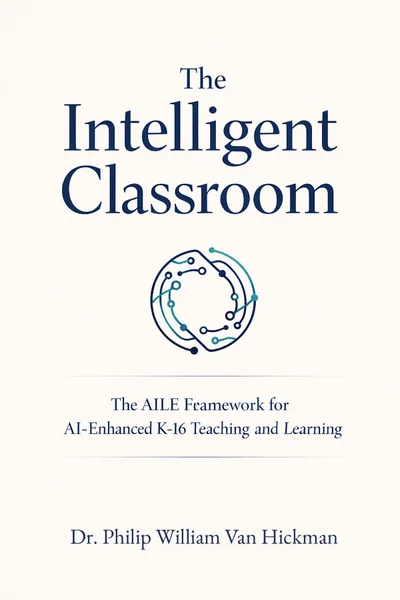 From the bookThe Intelligent ClassroomThe AILE Framework for AI-Enhanced K-16 Teaching and Learning