Parenting · AI and kids
What to say when your child asks AI for advice: scripts that work
Kids now ask chatbots and smart speakers should-questions about friends and feelings. Word-for-word scripts, by age, keep your voice in the room.
 Dr. Philip Hickman · 6 min read
Picture a nine-year-old at the kitchen counter after school. A classmate copied her spelling test, and she can’t decide whether to tell. So she asks the smart speaker. The ring of light spins, and a calm voice gives her a thoughtful, balanced answer about honesty and loyalty. It isn’t a bad answer. That’s not the problem. The problem is that she asked the kitchen instead of you.
Kids aren’t doing anything wrong when they ask a machine. They’re doing what they’ve watched the grownups do a hundred times. Our job isn’t to scold the question. It’s to make sure the important questions find their way back to a person.
Why a confident voice wins
Children trust confident voices, and AI always sounds confident, whether it’s right, wrong, or simply guessing.
Young children are actually good at tracking who has been right before. They keep a little scorecard on the adults around them. But a chatbot doesn’t stumble, blush, or say “um.” It answers a question about the moon and a question about whether your best friend still likes you in the same warm, steady voice. A child’s built-in trust detector has nothing to grab.
This isn’t rare. In a national survey released by the Pew Research Center in late 2025 and early 2026, 64 percent of American teens said they use AI chatbots, and 12 percent said they had used one for emotional support or advice. Picture a high school cafeteria and count off every eighth kid.
“What” questions and “should” questions
Here is the sorting rule I give parents. Kids usually start with what questions: How far away is the moon? How do you spell “necessary”? Those have an answer out in the world, and AI handles them reasonably well, though not perfectly.
Then, often without anyone noticing, they drift into should questions. Should I tell on him? Does she still like me? Is something wrong with me?
A should question about your own life needs two things a machine doesn’t have: knowledge of the people involved, and the standing to weigh in on how your family thinks about right and wrong. The answer to a should question always carries somebody’s values. You want those values to be yours.
The rule behind every script
In Raising Humans in an AI World I give families four short rules, the Four Family Rules. They’re short enough for a seven-year-old to say at breakfast:
- Think first. Try before you ask.
- Do the hard part yourself. AI can help you learn, but it can’t learn for you.
- Check before you trust. Real, fake, and everything in between.
- Bring the big stuff to people. Feelings, health, safety, and relationships go to humans.
When your child asks AI for advice, Rule 3 covers the facts and Rule 4 covers the heart. Every script below serves one of those two.
Script 1: When you overhear it
Your instinct may be to go after the machine. Don’t. If you attack the AI, your child will defend it, and now you’re arguing about technology instead of talking about values. Use these four steps, in this order.
- Get curious. “Oh, interesting. What did it say exactly?”
- Ask what they think. “Do you agree with it? What part made sense to you?”
- Share what your family thinks, and why. “Here’s how I see it, and here’s where that comes from for me.”
- Name the difference. “It gave you one way to look at it. That’s not wrong. But it doesn’t know your friend, and it doesn’t know us. That’s why I’m glad you brought it here.”
You don’t have to win. You just have to make sure your voice is in the room.
Script 2: Teach “a starting guess”
The phrase I want every child to carry is this: AI gives you a starting guess. Not “AI is wrong,” which isn’t true, and kids will figure that out. Not “AI is always right,” which is worse. A starting guess is something you can use, check, build on, and sometimes throw away. It respects the tool and keeps your child in charge.
Here’s how it sounds at different ages.
Ages 3 to 6. “That speaker is a machine that’s really good at finding words. But it’s never met your friend. It doesn’t know her like you do.” If your child thanks the speaker, let it go: “It’s a machine, and it doesn’t have feelings, but I like that you’re polite.”
Ages 7 to 10. “That’s the speaker’s starting guess. Who do you think would know for sure?” For facts, the answer might be a book or a teacher. For people questions, the answer is almost always a person.
Ages 11 and up. “What would make this answer wrong?” A teenager who learns to look for the weak spot in an AI answer is building one of the most valuable skills there is. Teens also respond well to plain talk about how these tools work: they predict what words should come next, and when they don’t know, they may produce a confident guess anyway.
Script 3: Name the dinner questions
Tell your kids directly which questions belong at the table. I’d say it like this:
“Questions about friends, fairness, feelings, and what kind of person to be are dinner questions. You can ask AI too. But bring them here.”
A quick checklist of the questions that should reach a person:
- Loyalty and honesty: Should I tell? Should I cover for her?
- Fairness: Is it okay to keep the extra change?
- Duty and comfort: Do I have to go? Do I have to apologize if I didn’t mean it?
- Identity and belonging: Who am I? What does our family stand for?
- Anything about feelings, health, safety, or relationships
Script 4: When they do bring it to you
The scripts above only work if you’re safe to talk to. Your child decides whether to bring you the next hard thing based on what your face did the last time. I call it the ten-second face: the expression, tone, and first words in the ten seconds after a child tells you something.
Keep a few lines in your back pocket:
- “Thank you for telling me.”
- “Okay. I’m listening. Tell me more.”
- “You’re not in trouble for asking.”
And skip “Why would you ask a computer that?” It teaches exactly the wrong lesson.
A game that does the teaching for you
From about age six, try a game I call Catch the Robot. Sit down with a chatbot and take turns asking it things you already know: your dog’s name, your street, what happened at last Saturday’s game. When it admits it doesn’t know, praise it out loud: “Good job, robot. That’s honest.” When it guesses wrong with total confidence, your child gets a point.
After a few rounds, ask one quiet question: “So when you have a question about your friends or your feelings, who should you ask?” Then let your child answer it.
What to do this week
- At a calm moment, ask your child, “What’s the last thing you asked a speaker or a chatbot?” Just listen.
- Teach the phrase “a starting guess,” and use it yourself, out loud, when you check something.
- Name the dinner questions at one meal this week.
- Play Catch the Robot once.
- Practice the ten-second face on something small: a forgotten assignment, a spilled drink.
When you’re ready to put your family’s version on paper, start with the free Family Rules tool.
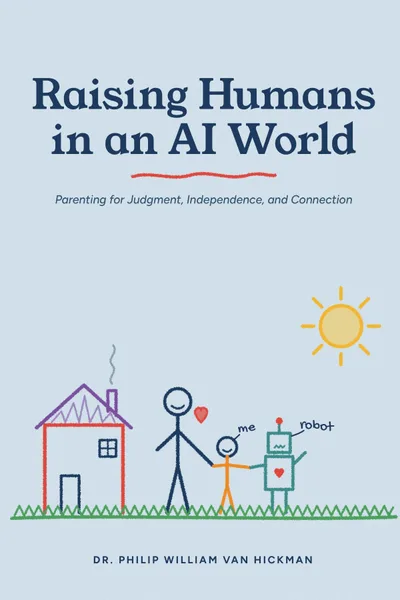 From the bookRaising Humans in an AI WorldParenting for Judgment, Independence, and Connection